
Pickleball Paddle Surface Texture Types: 2026 Guide
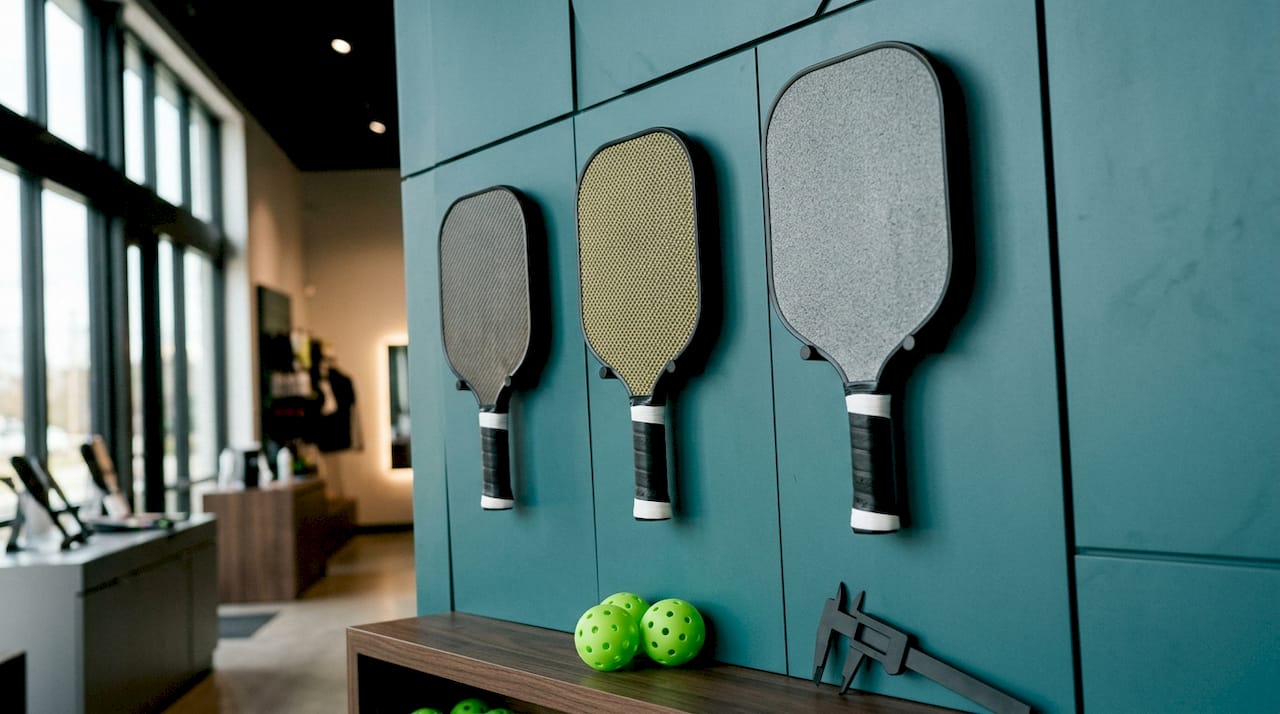
Pickleball paddle surface texture is defined as the physical roughness or finish on a paddle face that directly determines how much spin, control, and feel a player generates on every shot. The three dominant pickleball paddle surface texture types are raw carbon fiber weaves, Kevlar (aramid) grit finishes, and spray-on grit coatings. Each creates a different friction profile between paddle and ball. USAPA and IFP regulations cap legal surface roughness at Rz 30μm and Ra 10μm, so understanding these textures also means understanding what keeps your paddle legal in 2026.
1. Pickleball paddle surface texture types explained
Surface texture is the single most misunderstood spec on a paddle label. Most players focus on weight or grip size, but texture determines how the ball grips the face at contact. A rougher surface creates more friction, which translates to more spin. A smoother surface offers a cleaner, more predictable rebound. The right choice depends on your playing style, not on marketing language.
Carbon fiber accounts for roughly 45% of premium paddle production. That dominance reflects real performance advantages in stiffness, energy transfer, and texture durability. Fiberglass holds about 35% of mid-range production, where applied coatings are more common. Knowing which base material carries which texture type helps you shop with clarity.
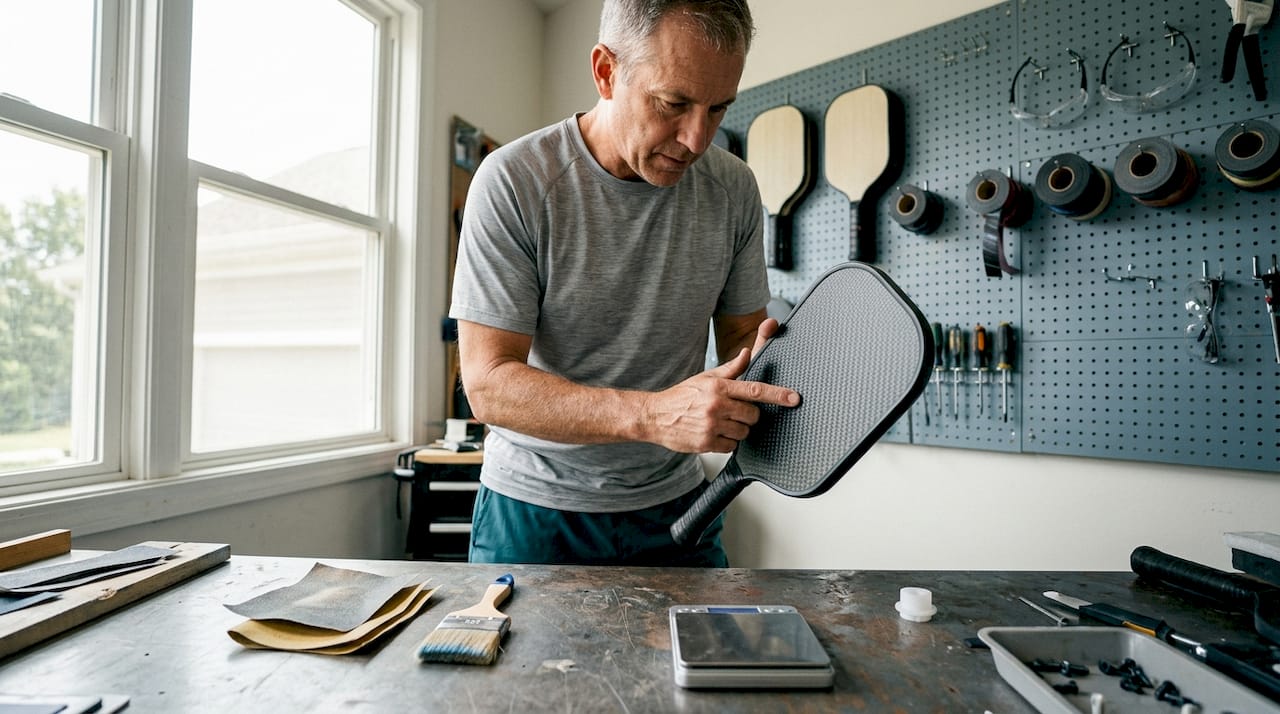
2. Carbon fiber weave texture: the integrated approach
Carbon fiber surface texture does not come from a coating. It comes from the woven fabric itself. The weave pattern creates peaks and valleys across the face, and those micro-ridges grip the ball at contact. This is called an integrated or raw texture, and it is fundamentally different from anything sprayed or applied after manufacturing.
Carbon fiber grades produce meaningfully different roughness levels:
- T700 weave produces a surface roughness of approximately Rz 8μm. It is the smoothest of the common grades and favors control over spin.
- 3K weave reaches approximately Rz 12μm. It balances spin and feel, making it the most popular choice for all-around players.
- 18K weave reaches approximately Rz 15μm. It offers the most texture of the three and suits players who prioritize spin generation.
All three grades fall well within the USAPA Rz 30μm legal limit, so compliance is not a concern with standard raw carbon fiber faces.
Pro Tip: Run your fingertip lightly across the paddle face. A genuine raw carbon fiber surface feels like fine woven fabric with a consistent grain. If the texture feels gritty or uneven in patches, the paddle likely has a spray-on coating over a carbon fiber base, not a true raw weave.
The durability advantage of raw carbon fiber texture is significant. Because the texture is part of the material structure, it does not wear off the way applied coatings do. Players who compete frequently and want consistent spin performance over months of play get better long-term value from integrated weave textures.
3. Kevlar grit finishes: aramid fiber for added friction
Kevlar, technically an aramid fiber, appears in paddle faces as a woven material similar to carbon fiber. Some manufacturers apply Kevlar-based grit coatings directly onto the paddle face to increase surface roughness beyond what the base material provides. The result is a paddle with noticeably higher friction and a distinctive feel at contact.
Kevlar grit finishes offer several specific advantages:
- Higher friction than raw carbon fiber at equivalent weave grades, which means more spin on topspin drives and drop shots.
- Impact resistance that exceeds standard carbon fiber, reducing the risk of face cracking on mishits.
- Texture durability that sits between raw carbon fiber and spray-on coatings. The aramid structure resists abrasion better than most applied coatings.
- Legal compliance when the roughness stays within the USAPA Ra 10μm and Rz 30μm limits.
The feel of a Kevlar grit surface is distinct. Players describe it as slightly “grabby” compared to raw carbon fiber. That grab translates to more ball rotation but can reduce the clean, crisp feedback that control-focused players prefer.
Pro Tip: Kevlar grit surfaces show wear as a gradual smoothing of the face rather than visible flaking. Check your paddle face under direct light every few weeks. If the surface looks uniformly shiny rather than slightly matte, the grit has worn down and spin performance has dropped.
Maintenance matters with Kevlar grit finishes. Cleaning the face with a damp cloth after play removes ball residue that can fill the micro-texture and reduce friction. Avoid abrasive cleaners, which accelerate surface wear.
4. Spray-on grit coatings: applied texture and its trade-offs
Spray-on grit coatings are the most common texture upgrade applied to entry-level and mid-range paddles. Manufacturers bond particles of aluminum oxide or silicon carbide onto the paddle face using an epoxy base. The result is a rough surface that can significantly increase spin potential without changing the underlying paddle material.
Spray-on coatings must be bonded and non-peelable to meet USAPA rules. A coating that flakes or peels during play is illegal. Quality spray-on grit uses controlled particle sizes ranging from 80 to 220 grit equivalent, with coarser particles generating more spin and finer particles offering a smoother feel.
Key considerations for spray-on grit surfaces:
- Spin potential is high initially but decreases as particles wear down with use.
- Compliance requires verification. Particle size and bonding method must keep roughness within Rz 30μm.
- Lifespan is shorter than integrated textures. Heavy players may notice spin loss within a few months.
- Cost is lower than raw carbon fiber or Kevlar grit paddles, making spray-on grit a practical entry point for recreational players.
The practical downside is consistency. A new spray-on grit paddle feels very different from the same paddle after 60 hours of play. Players who rely on spin-heavy strategies need to account for this degradation when planning paddle replacement cycles.
5. Comparing surface textures: performance, durability, and compliance
Choosing between texture types requires understanding how each performs across the factors that matter most on court.
| Surface texture | Spin potential | Durability | USAPA compliance | Best for |
|---|---|---|---|---|
| Raw carbon fiber (T700) | Moderate | Excellent | Fully compliant | Control players |
| Raw carbon fiber (3K/18K) | High | Excellent | Fully compliant | All-around and spin players |
| Kevlar grit finish | Very high | Good | Compliant within limits | Spin specialists |
| Spray-on grit (fine, 150–220) | High initially | Fair | Compliant when bonded | Recreational players |
| Spray-on grit (coarse, 80–120) | Very high initially | Fair to poor | Must verify roughness | Aggressive spin players |
Texture does not work in isolation. Spin potential depends on texture, core thickness, and dwell time working together. A very stiff paddle core shortens the time the ball stays in contact with the face, which reduces how much the texture can grip the ball. This means a heavily textured face on an ultra-stiff paddle may underperform a moderately textured face on a paddle with a softer, thicker core.
Fiberglass paddles with foam cores produce 15–20% more ball rotation on topspin shots compared to smooth carbon fiber variants. That gap narrows significantly when carbon fiber paddles carry a 3K or 18K weave texture. The lesson is that surface texture and core construction are a system, not separate variables.
Competitive players should prioritize integrated textures (raw carbon fiber or Kevlar weave) for consistent performance across a full season. Recreational players who play two to three times per week can get strong results from quality spray-on grit paddles at a lower price point.
6. Which surface texture fits your game?
The right paddle texture depends on three things: your skill level, your dominant shot type, and how often you play.
- Control-focused players benefit most from T700 raw carbon fiber. The moderate texture gives reliable feedback without excessive spin that can make placement unpredictable.
- All-around players perform well with 3K weave carbon fiber. It covers both spin and control without forcing a trade-off.
- Spin specialists should look at 18K weave carbon fiber or Kevlar grit finishes. Both generate the friction needed for heavy topspin and aggressive third-shot drops.
- Recreational players who want spin at a lower price point get solid results from quality spray-on grit paddles, provided they replace them when texture wear becomes noticeable.
Core interaction matters as much as face texture. A 16mm polymer honeycomb core paired with a 3K carbon fiber face gives more dwell time than a 13mm core, which amplifies the texture’s spin effect. When testing paddles before purchase, hit several topspin shots and note how much the ball kicks after bouncing. That kick is the texture and core working together.
Pro Tip: Ask your local pro shop to let you hit with demo paddles on the same day. Texture feel changes with temperature and humidity, so testing in real conditions gives you a more accurate read than handling a paddle in a store.
Paddle sizing and care also affect how texture performs over time. A paddle that is too heavy for your arm causes you to swing late, which reduces the clean face contact that texture requires to generate spin.
Key takeaways
Surface texture type is the most direct lever a player has for improving spin and control through equipment selection.
| Point | Details |
|---|---|
| Integrated texture lasts longer | Raw carbon fiber weave texture does not wear off, unlike spray-on grit coatings. |
| Weave grade changes roughness | T700 sits at ~Rz 8μm; 3K at ~Rz 12μm; 18K at ~Rz 15μm, each affecting spin differently. |
| USAPA limits apply to all textures | Legal surfaces must stay within Rz 30μm and Ra 10μm under 2026 regulations. |
| Core stiffness affects texture performance | A stiff core reduces dwell time, which limits how much even a rough face can grip the ball. |
| Match texture to playing style | Control players favor T700; spin specialists benefit from 3K, 18K, or Kevlar grit finishes. |
What I’ve learned watching texture technology evolve
The shift toward raw carbon fiber weaves as the dominant premium texture is not marketing. It reflects a real performance gap that players notice after a few months of serious play. I have watched players switch from spray-on grit paddles to 3K weave paddles and immediately report more consistent spin on third-shot drops, not because the new paddle is “better” in some vague sense, but because the texture does not change from week to week.
The most underrated factor in this conversation is core interaction. Players obsess over face texture and ignore core thickness. A 3K carbon fiber face on a 13mm core plays very differently from the same face on a 16mm core. The thicker core gives the ball more time to press into the texture, which is where spin actually comes from. Buying a textured paddle without considering core thickness is like buying performance tires for a car with worn suspension.
My honest advice for competitive players is to treat integrated texture as a baseline requirement, not a premium feature. The durability alone justifies the cost difference over spray-on grit. For recreational players who play once or twice a week, a quality spray-on grit paddle at a mid-range price point is a perfectly rational choice, as long as you replace it when the face starts looking shiny.
The next wave in surface texture will likely involve hybrid weaves that combine carbon fiber and aramid fibers in the face itself, creating integrated textures with Kevlar-level friction and carbon-level durability. That technology is already appearing in higher-end paddles and will filter down to mid-range options within the next two years.
— extradom
Lymexa paddles built for texture-driven performance
Players who take surface texture seriously need equipment that holds up to that standard across every session.

Lymexa’s premium pickleball paddles are built with performance-grade surface materials designed to deliver consistent spin and control from the first game to the hundredth. The paddle lineup covers players at every level, from recreational players looking for reliable grit to competitive players who need integrated texture that performs all season. Lymexa also offers recovery and practice gear that supports your full game, not just your equipment. When your paddle, your training, and your recovery all work together, your performance reflects it.
FAQ
What are the main pickleball paddle surface texture types?
The three main types are raw carbon fiber weave, Kevlar (aramid) grit finish, and spray-on grit coating. Each creates different friction levels that affect spin, control, and durability.
What is the legal roughness limit for paddle surfaces in 2026?
USAPA and IFP regulations cap paddle surface roughness at Rz 30μm and Ra 10μm. Any paddle exceeding these limits is not approved for sanctioned play.
Which paddle surface texture generates the most spin?
18K raw carbon fiber weave and Kevlar grit finishes generate the most spin among legal textures. Both reach roughness levels near the upper range of USAPA compliance while maintaining durability.
Does spray-on grit wear off over time?
Spray-on grit coatings do wear down with use, reducing spin performance as particles erode. Raw carbon fiber and Kevlar weave textures maintain their roughness significantly longer because the texture is part of the material structure.
How does core thickness affect surface texture performance?
A thicker paddle core increases dwell time, which gives the textured face more contact time with the ball and amplifies spin. A very stiff, thin core shortens dwell time and reduces the effectiveness of even a heavily textured face.
Recommended
Play and recover — from one place.
Shop the kit →