
How to Read Opponent Pickleball Strategy in 2026
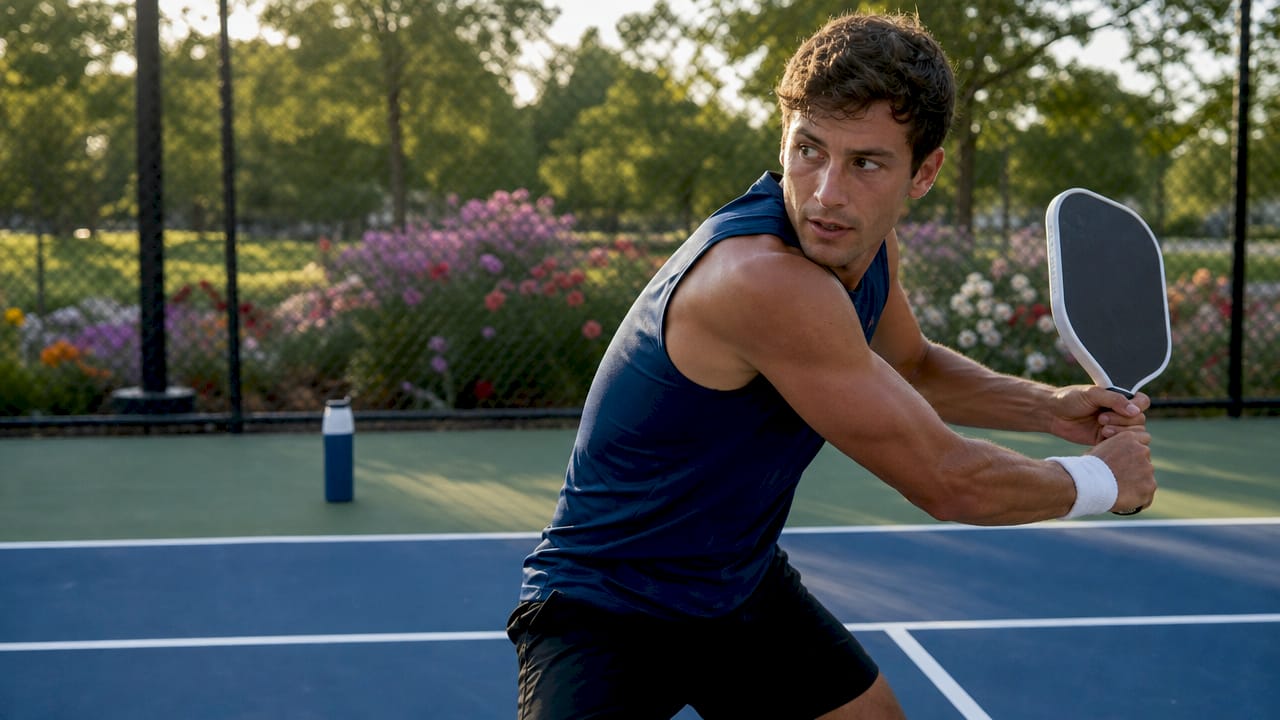
Reading opponent pickleball strategy is the process of interpreting physical cues, behavioral patterns, and court geometry to anticipate shots before they happen. Competitive players who master this skill gain a measurable edge over opponents who rely on pure reaction speed. The core tools are observation and anticipation, not athleticism. Subtle signals like paddle face angle, foot placement, and shoulder alignment reveal an opponent’s next shot well before contact. This guide breaks down exactly how to gather that intelligence, interpret it accurately, and turn it into tactical decisions that win points.
What are the key pre-shot cues to read in your opponent?
Paddle face angle is the most reliable predictive cue in pickleball. An open paddle face signals a soft shot or lob. A closed face signals a drive. Reading this cue alone gives you a half-second head start on positioning, which is often the difference between a clean return and a scramble.
Body alignment tells you where the shot is going. Shoulder and hip direction typically point toward the intended target zone. When an opponent’s shoulders rotate toward the sideline, a cross-court shot is the most likely outcome. Train yourself to watch the torso, not just the paddle.
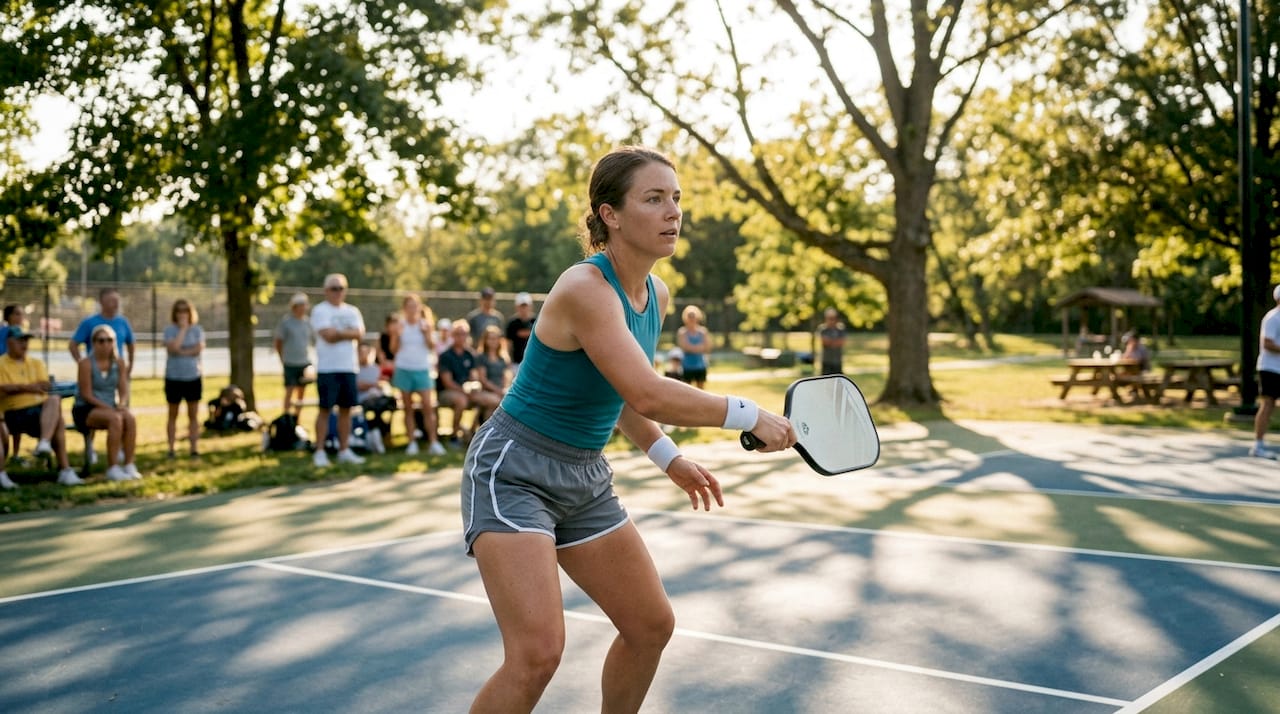
Foot placement reveals balance and court coverage intent. A player leaning forward on the balls of their feet is preparing to attack. A player with weight on their heels is likely to defend or reset. Uneven footing often means a rushed shot with less placement control.
Grip changes are a subtler but valuable signal. A tighter grip usually precedes a speed-up or drive. A looser grip suggests a dink or drop shot. Grip and contact point together form part of the cue stack that advanced players use to narrow shot possibilities before the ball is struck.
- Paddle face: Open face means soft or lob; closed face means drive
- Shoulder and hip direction: Points toward the intended shot target
- Foot balance: Forward lean signals attack; back lean signals defense
- Grip tension: Tight grip precedes power shots; loose grip precedes soft shots
- Contact window: High contact favors drives; low contact favors drops or dinks
Pro Tip: Watch your opponent’s shoulder, not the ball, during the backswing. The shoulder rotation commits to a direction before the paddle does.
How to systematically gather opponent tendencies during a match
The 10-Point Rule is the most practical framework for live opponent analysis. It advises using the first 10 points of a match to observe opponent tendencies rather than forcing your own game. That means playing neutral, consistent pickleball while cataloging what you see.
What should you track during those early points? Focus on these specific tendencies:
- Backhand weakness: Does the opponent avoid their backhand or produce weak returns from that side?
- Drift patterns: Does the player drift wide after serving or returning, leaving the middle exposed?
- Speed-up lanes: Which direction does the opponent favor when attacking from the kitchen line?
- Shot preferences: Does the player rely heavily on drives, lobs, or dinks under pressure?
- Serve patterns: Does the opponent serve to the same zone repeatedly, or vary placement?
Mental note-taking during matches significantly increases win rates in rematches. Tracking specific quirks like a “lefty spin serve” or a “backhand vulnerability” gives you a ready-made game plan the next time you face the same player. After a match, write down two or three key tendencies while they are still fresh.
| Tendency to Track | What to Watch For |
|---|---|
| Backhand weakness | Errors or weak returns from the left side (right-handed players) |
| Drift pattern | Court position after serve or return |
| Speed-up lane | Direction of kitchen line attacks |
| Shot preference | Go-to shot under pressure or when leading |
| Serve target | Consistency or variation in serve placement |
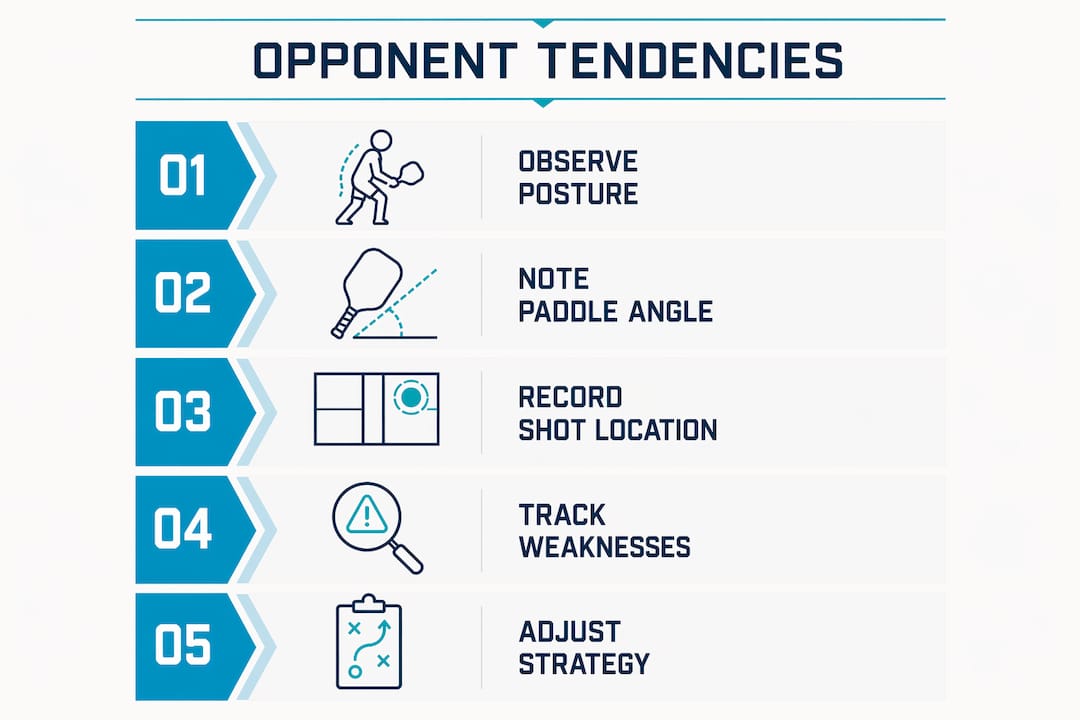
Pro Tip: Use a simple shorthand system after each game. Three words per opponent tendency is enough. “Weak BH cross” or “lobs when rushed” will jog your memory before a rematch.
How does court geometry help you anticipate opponent shots?
Anticipation in pickleball is a trained skill built on pattern recognition and court geometry, not instinct. Most players lose points by reacting to ball speed rather than predicting shot outcome based on where the opponent stands and what angles are available to them.
Court geometry limits what your opponent can do from any given position. A player caught wide near the sideline has a narrow cross-court window and almost no down-the-line angle. Knowing this, you can pre-position toward the most likely shot before the opponent even swings. That is anticipatory positioning, and it is faster than any reaction.
“Reaction is often a result of prediction. Players who understand court geometry narrow the possible shot outcomes before ball contact, giving themselves a head start that pure speed cannot replicate.”
Defending dinks at the kitchen line is a clear example. When your opponent is dinking from their backhand corner, the most probable shot is a cross-court dink or a straight reset. You do not need to cover every angle equally. Shift your weight slightly toward the high-probability zone and you will reach more balls with less effort.
Pattern recognition builds over time. The more matches you play with deliberate attention to opponent positioning, the faster your brain maps likely outcomes to specific court scenarios. Deliberate practice on pre-shot cues produces noticeable improvement in anticipation within two to four weeks.
- Pre-position before contact: Move toward the high-probability shot zone before the opponent swings
- Use sideline pressure: Force opponents wide to reduce their available angles
- Kitchen line awareness: Know which dink directions are geometrically available from each court zone
- Narrow the field: The fewer shot options your positioning leaves, the easier anticipation becomes
How to adapt your strategy based on what you observe
Exploiting a weakness only works if you apply it consistently. If you identify a backhand vulnerability in the first 10 points, start targeting it deliberately in the middle of the match. Do not wait for a perfect setup. Create the setup by serving wide, dinking cross-court, or forcing movement that exposes the weak side.
Changing ball speed and shot placement disrupts opponent rhythm. A player who has settled into a comfortable dinking exchange will struggle when you introduce a sudden speed-up to their hip. High-IQ players treat patience as an aggressive skill, using it to force errors by waiting for the right moment rather than forcing plays prematurely.
Knowing when to press and when to stay patient requires reading opponent composure. A composed opponent under pressure will reset well and wait for your mistakes. An anxious opponent will rush, overhit, or go for low-percentage shots. Adjust your tempo accordingly.
- Target the weak side: Serve and dink to the backhand consistently once identified
- Vary serve targets: Change serving zones every few points to gather new data and prevent adjustment
- Change dinking tempo: Speed up or slow down to test opponent composure
- Force movement: Use wide shots to pull opponents off balance before attacking the open court
- Deliberate changes: Every tactical shift is also a data-gathering opportunity
Pro Tip: If an opponent adjusts to your pattern, make one deliberate change and observe the response. Treat every adjustment as a new experiment, not a concession.
Common mistakes when reading opponents in pickleball
Over-reliance on a single cue is the most common error in opponent analysis. Watching only the paddle face while ignoring footwork and body alignment produces false reads. The cue stack of contact point, shoulder and hip orientation, footwork, and court position gives far more accurate predictions than any single signal.
Failing to gather enough live data before adjusting strategy is the second major mistake. Players who change their game plan after two or three points are working with a sample size too small to be reliable. The 10-Point Rule exists precisely to prevent this error.
Reacting instead of anticipating costs time and position. A player who waits to see where the ball goes before moving will always be a step behind. The goal is to move before contact, not after.
- Single-cue reliance: Always read paddle angle, body alignment, and footwork together
- Premature adjustment: Gather at least 10 points of data before changing your core strategy
- Pure reaction: Pre-position based on court geometry, not ball trajectory
- Ignoring psychology: A composed opponent plays differently under pressure than an anxious one
- No post-match review: Skipping the mental debrief means losing the data you collected
Pro Tip: After a tough loss, replay three specific points in your head and ask what cue you missed. One honest review per match builds reading skills faster than any drill.
Key Takeaways
Reading opponent pickleball strategy requires combining pre-shot cue observation, systematic data gathering, court geometry awareness, and real-time tactical adjustment to gain a consistent competitive edge.
| Point | Details |
|---|---|
| Paddle face is the primary cue | Open face signals soft shots; closed face signals drives. Read it before the swing. |
| Use the 10-Point Rule | Spend the first 10 points observing tendencies before forcing your own game plan. |
| Anticipation beats reaction | Pre-position based on court geometry to reach balls faster than pure reaction allows. |
| Build a cue stack | Combine paddle angle, body alignment, footwork, and court position for accurate reads. |
| Track and review tendencies | Note opponent weaknesses after each match to build a ready-made game plan for rematches. |
Why reading opponents changed how I play pickleball
The biggest shift in my game did not come from a better serve or a faster reset. It came from learning to watch before I moved. For years, I played reactive pickleball. I waited to see the ball, then scrambled. I was fast enough to survive, but I was always a step behind the best players I faced.
The turning point was forcing myself to watch shoulder rotation instead of the ball during the backswing. That single habit change made opponents feel slower, not because they were, but because I was moving earlier. Anticipatory positioning is not a talent. It is a trained attention habit.
What I have found is that patience is genuinely aggressive. Waiting for the right moment to attack a backhand, rather than forcing it on every third ball, produces cleaner winners and fewer unforced errors. The players who beat me consistently are not faster. They are more patient and more observant.
My honest advice: treat every match as a scouting session, even when you are winning. The data you collect on an opponent’s drift pattern or speed-up lane is worth more than any single point you might win by gambling on a low-percentage shot. Competitive pickleball rewards the player who knows more, not just the one who moves faster.
— extradom
Gear that keeps you sharp when strategy demands precision
Executing the shots that your opponent reading calls for requires equipment that responds to your intent, not against it. A paddle with the right weight and surface texture lets you place dinks, drives, and resets exactly where your analysis says they need to go.
Lymexa builds premium pickleball paddles and recovery gear specifically for competitive players who train with purpose. The paddle lineup is designed for control and feel, so your tactical decisions translate directly into shot execution. The recovery gear, including natural rubber mats built for post-match conditioning, keeps your body ready for the quick, agile movement that opponent reading demands. When your equipment matches your skill level, strategy stops being theoretical and starts winning points.
FAQ
What is reading opponent pickleball strategy?
Reading opponent pickleball strategy is the process of observing physical cues like paddle angle, body alignment, and footwork to anticipate shots before they are struck. It converts reaction into prediction, giving players a positioning advantage.
What is the 10-Point Rule in pickleball?
The 10-Point Rule advises using the first 10 points of a match to observe opponent tendencies, including backhand weaknesses and speed-up lanes, rather than forcing your own game plan immediately.
How quickly can players improve at reading opponents?
Deliberate practice focused on pre-shot cues produces noticeable improvement in anticipation within two to four weeks. Consistent attention to paddle angle, body rotation, and footwork accelerates the learning curve.
What is a cue stack in pickleball?
A cue stack is the combination of contact point, shoulder and hip alignment, footwork, and court position that advanced players read together to predict opponent shots. Relying on a single cue produces false reads; the full stack produces accuracy.
How does court geometry help with anticipation?
Court geometry limits the shot angles available to an opponent from any given position. Understanding those limits lets you pre-position toward the most likely shot before contact, which is faster and more reliable than reacting to ball speed alone.
Recommended
Play and recover — from one place.
Shop the kit →